

Each cycle, in order
1
Settle the veto window
If the coin has veto on and a 24-hour window just closed, the engine tallies the vetoes. The creator’s escrow is either paid to the creator or moved to buyback and burn. How vetoes work.
2
Claim
The engine checks the coin’s creator vaults on the bonding curve and on PumpSwap. If at least 0.01 SOL is waiting, it claims it into the coin’s fee vault. Smaller amounts wait for a later cycle, since claiming them would cost more than they’re worth.
3
Split
20% goes to the platform and buys back $VETO. The rest is added to the coin’s four pots in the proportions set at launch.
4
Draw the jackpot
If the jackpot pot has reached its draw size, one eligible holder is picked and paid the whole pot. Jackpots.
5
Buy back and burn
If the buyback pot holds at least 0.01 SOL, the engine buys the coin with all of it and burns exactly what it bought. Buyback and burn.
6
Pay holder rewards
If the rewards pot holds at least 0.005 SOL, it’s credited to holders by bag size. Anyone whose balance has reached the minimum payout is paid. Holder rewards.
7
Pay the creator
With veto off, the creator pot is paid out once it holds at least 0.005 SOL. With veto on, it stays in escrow until the window closes.
Watch it happen
Every coin page shows its pots filling up and the countdown to the next cycle. Each payout lands in the coin’s activity feed and on live payouts, linked to its transaction.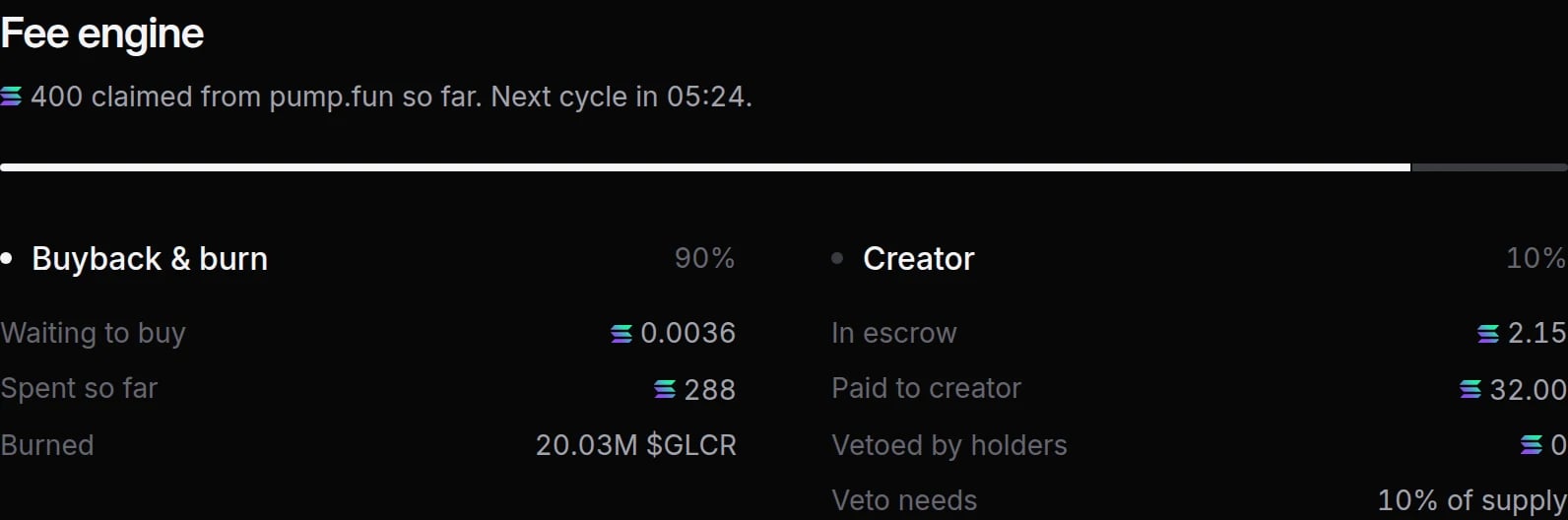
Thresholds
For coins paired with something other than SOL, thresholds are compared by value using live prices, and payouts happen in the pair asset. Pairing.
Anything under a threshold stays in its pot and rolls into the next cycle. Nothing is lost.
Who counts as a holder
Jackpots, rewards and veto tallies all use a snapshot of the coin’s holders taken during the cycle. These never count:- the bonding curve and the PumpSwap pool,
- the coin’s own fee vault,
- program-owned accounts (addresses that can’t sign, like pools and vaults of other protocols),
- wallets the creator excluded at launch.